.png)

2025
September Newsletter
This month’s stories are about a hillside path that finally became a real road, turmeric that disappeared and returned, coconuts that turned into a luxury, and kids who discovered that “I feel happy” is a powerful sentence.
We’d love to hear from you. Which story touched you most? Which one reminded you of your own life? Reply, comment, or share your reflections. Your words matter more than you know.
With love & hope, Lorliang Cheewa Foundation
Whats inside this month
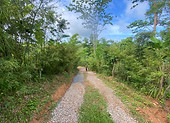


Imagine a road. Now erase the road part and keep only the mud, the gravity, and the feeling that nature itself is betting against you. That is our road to the future learning center.
When it rains even a little, it does not just get slippery. It transforms into a mini waterfall. One time, we got stuck halfway up with a truckload of supplies, wheels spinning, water rushing around us. The rescue plan was a giant plank of wood, family members running to help, and my uncle joking, “ต้องเรียกกู้ภัยมาช่วยผู้ประสบภัยแล้ว,” as if we were official flood victims waiting for emergency response.
The local government later came, nodded seriously, and recommended a proper concrete road. The price tag was several hundred thousand baht. We gulped. So, like villagers have done for centuries, we shrugged and figured it out ourselves.
Truckloads of gravel. Big rocks. Mud that clung to our boots as if it wanted to swallow us. We dropped boulders into holes that looked bottomless. One shovel at a time, we fought gravity, rain, and exhaustion. And somehow, we won.
Now, the road is sturdier and safer for children to walk without fear in every season.
Lesson? Sometimes the way forward isn’t a grand plan or a government project. Sometimes it’s a plank under a spinning wheel and a family laughing in the rain and that’s enough to keep moving.
2.The Case of the Missing Turmeric and the Coconut Crisis


When I was a kid, food did not come from shops. It grew around you like oxygen. Lemongrass and galangal by the kitchen door. Turmeric bushes under the trees. Chili plants a few steps away. The market was outside your house, and the cashier was whoever remembered to pick before cooking.
Fast forward to now, and people buy everything. Even chili paste comes in plastic bags. For a proud southerner like me, this is not a small shift. It is a cultural earthquake. Because what dish defines the south? แกงส้ม. And you cannot make it without turmeric.
So we planted again. Not to sell, but to revive the way of life that once made us belong. We share with neighbors for free because this is not about becoming the village vegetable shop. It is about remembering who we are.
And here is where it gets absurd. The single most luxurious item in the village right now is fresh coconuts. Yes. Fresh coconuts. When I write this, my finger wants to press the exclamation key over and over, because this is a real crisis.
Coconuts are the backbone of southern food: curries, soups, desserts. Imagine ขนมโค without grated coconut hugging that warm sweet filling. Imagine ลวกทิยอดเกรียง without coconut milk. That is not just missing a flavor, it is erasing a part of who we are.
When I was small, coconuts fell everywhere. Now, they sell for 25 baht each. I have even heard whispers of people sneaking into neighbors’ yards to steal them. That is how desperate it has become. Real coconut milk, the grated, hand squeezed kind, has turned into a luxury item.
So we planted more than 20 coconut trees on our little land. Now we count the years like patient gamblers waiting for the jackpot. Because one day, we will have enough to share. No more coconut scarcity. We simply refuse to accept it.
And here is the hidden blessing. For the past four months, we have not bought a single fruit. Passion fruit, guava, sapodilla, star fruit, we eat what we grow. We even boil our own cane sugar. Golden, fragrant, pure. The kids at school love the snacks. The monks smile when we bring them offerings. For us, this is more than food. It is dignity, resilience, and joy disguised as guava.
3.The Palm Tree Dilemma


Our land has maybe 20 or 30 oil palm trees. I never counted, because to be honest, I do not like them. They feel like strangers in the family. My stepdad planted them for income, and when he passed away this April, they became mine.
Cutting them down is not an option. My mom and grandma would be devastated. They adore the little cash from palm fruit sales. So I made peace with the palms, or at least a ceasefire.
We use the fronds for compost. We toss the fruit to ducks and chickens, who stare at us blankly. But the story we want to tell here is not about the chickens. It is fertilizer.
Ask any farmer. Fertilizer is the villain of the budget. One sack costs over a thousand baht. For families living harvest to harvest, it is suffocating. And the cruelest part is that chemical fertilizer does not feed the soil. It drains it.
When my husband and I came back home two years ago, I thought I was standing in Africa’s dry season. Cracked earth. Dusty yellow everywhere (see the third photo on the left). The only green survivors were the palms, smug and upright, draining both nutrients and, in some ways, my stepdad’s life.
My mom told me how it went. Each time he scraped together a little from rubber sales, he would jump on his motorbike, rush to buy a kilo or two of fertilizer. A hamster wheel of exhaustion. Round and round, never ending.
This was not just his story. It was mine too. I grew up in that wheel. Cucumbers covering entire fields. At one point, mountains of unsold cucumbers piled up, and still, nobody would pay even one baht a kilo. Because farmers never set the price. The market did. When everyone grew the same thing, everyone lost. Families collapsed under debt. Mine included.
I saw it all. Great grandparents, grandparents, parents. All farmers. All chemical heavy. Because markets demanded it. Officials encouraged it. And every season, the soil got worse, the money smaller, the dignity thinner.
Now, we are trying differently. Growing vegetables, yes, but experimenting. Composting. Failing sometimes, adjusting, trying again. Teaching village kids as we learn. Because what grows from the soil should feed us, not bury us in debt.
4.Dare to Dream: The Language of Feelings


Every Friday we walk into a small classroom at Ban Chonglom School. About 60-78 children wait for us. They are not waiting for iPads. Or after school soccer. They wait because this is what they have. A chance to learn. A chance to laugh. A chance to dream.
Their families work hard as tenant rubber tappers. Many children live with grandparents because their parents are apart or struggling. These kids carry more than children should. And yet their eyes are bright. They show up eager to learn. That is why our lessons are free. Not simple. Not easy. But free. Because here education is not extra. It is survival. It is confidence. It is resilience.
We had been thinking about how to talk to kids about drugs. Not by repeating the same old line: “Drugs are bad. Don’t use them.” Those words do not work. We have seen children as young as seven copy their family members and light a cigarette. In our own families we have brothers, fathers, and uncles who smoked. Habits pass down like inheritance.
We do not blame parents. But we want something different for these kids. We want their lungs safe. We want their lives safe. Worse than cigarettes is yaba, the meth that is pulling our village apart. At a community meeting last month, our leader said parents can now take children who are using drugs to the hospital for free treatment. That is good. But we want to stop it before we ever get there.
So we started with feelings. Because drugs are often a way to escape feelings. And if children learn early that feelings are not scary, then maybe they will not need to escape. We explored how happiness feels like an open chest and soft eyes. How anger feels like fire in the belly and a tight chest. How sadness makes knees buckle and hearts feel weak. How calm makes the body light and free.
Once we could name the feelings, we created tool bags. If you are sad, you can sing, pray, or talk to someone safe. If you are angry, you can run or play. If you are nervous, you can breathe slowly. Feelings come and go. They do not have to control you. And then the classroom came alive. Kids laughed. They guessed. They shouted answers in Thai and English. They filled their tool bags with colors and drawings.
A week later we were at the temple. A little girl named Bell ran up to us. Her eyes glowed. Out of nowhere she said, “I feel happy.”
Three small words. But in that moment it felt like the sky cracked open and let light pour in. Later, at a high school nearby, a teacher told us that in her class of 35 students, 17 have parents who struggle with drugs. Seventeen. That number shouts. It reminds us why Fridays matter so much. Our lessons are not just nice activities. They are first aid for the spirit.
And we are not doing this alone. Teachers continue the lessons through the week. And Khun Pantiwaporn, one of our committee members, joined us. She spoke openly about how drugs hurt families. But she did not make it heavy. She clapped. She sang. She laughed with the children. The kids did not shrink from her words. They danced with them.
We feel grateful. Grateful to walk alongside these children. Grateful to share seeds of joy resilience and hope. Grateful to see with our own eyes that even in a village full of challenges, children are eager, bright, and ready to build something new.
5.To Be Number One: Marching in the Rain
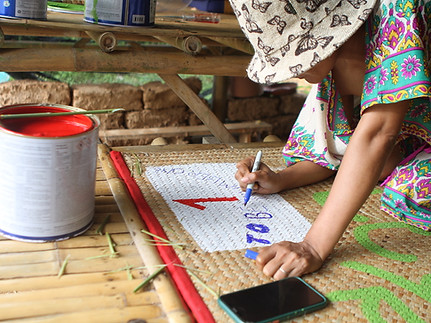


On September 13th, 2025. The To Be Number One parade. Bright banners. Costumes. And rain. Buckets of it. We carried our handmade foundation banner. Painted on a funeral mat that once held my stepdad’s body. Strange, yes. But also perfect. Grief turned into hope. Literally carried in our hands.
I used to roll my eyes at parades. “How is marching around with signs supposed to stop addiction?” But this time, as the rain soaked us through and we kept walking together, something shifted.
It was not about the signs. It was about the people. Walking side by side. Shouting joy into the rain. Parents,relatives, kids. Some of them I know still struggle with drugs. Others once did. But here we were, walking together, declaring that we want something better.
Sometimes the point is not the sign. It is the togetherness. It is saying, loudly and ridiculously soaked: we are not alone.
On the way back, a girl named Waan asked for a ride with us. She is quiet, with a gentle smile. I asked her what she thought about the parade. “It was good,” she said. Then she told me something else.
At her school, there are no activities when she feels sad or bored. No clubs. No space to go. No outlet except her phone or a nap.
Her honesty sat with me. Because it is not enough to march with banners once a year. If kids like Waan have no safe place for their energy, then boredom and sadness can become the doorway to something darker. So I asked her for ideas. Brilliant ideas. What kind of clubs? What hobbies? What would make her want to show up at school, even on hard days? She thought. She smiled. And in that moment, I realized: the answers are already in them. The kids know what they need. Our role is to listen. To ask. To make space.
After the parade, I went to speak with the juvenile detention center director. I wanted to know the numbers. The needs. How we could help. He welcomed the conversation. And that is where parades can lead. From walking in the rain, to listening in the car, to planning with leaders. Small steps. But steps together.
6.The Art of Dharma Dialogue


We sat silently at Wat Thung Luang and Wat Sitthichai. Monks from different temples shared wisdom. One line stuck: “Do not argue who is right. Just agree.” I nodded politely, but inside I argued. Some things need to be said. “Drugs are hurting our kids.” “Please do not dump trash in the fields.” The middle path, to me, is not silence. It is mindful courage.
And that is where I am now, learning to disagree with respect, learning from monks even as I challenge the message.


7.Quacks and Crafts

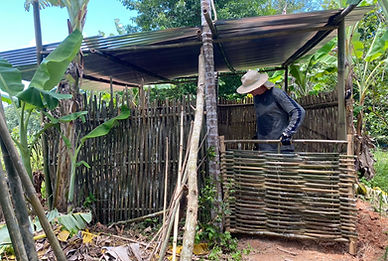

When we left Bangkok for Trang in the south of Thailand, people thought we were a little nuts. Who leaves the city with its iced coffee on every corner and air conditioning everywhere for mud, mosquitoes, and the strange decision to build everything out of earth and bamboo?
Especially for me it seemed crazy. I had been working with UN Women. A colleague asked, why not just take a sabbatical. But family and community are important. When I decide to do something, I cannot do it half way. Fifty fifty is not my plan. I want to make sure I am here, seeing what is important and what needs to be done. I believe we cannot learn anything important from far away.
So we came here. And bamboo became our thing.
Why. First, it is cheap. Second, it grows everywhere. Third, it makes you feel like a creative genius and a complete fool at the same time.
Take the duck house. We could have just bought nails. But no. We were on a mission. Zero waste. No nails. Only bamboo pins carved from scraps. Which sounds noble until you realize it means hours of whittling tiny sticks and wondering if the roof will collapse on a duck.
One week later, there it was. A duck house made of split bamboo, scrap tin, ropes, and sweat. And then came the duck catching.
We even asked ChatGPT for advice. It told us to hold the wings gently and send loving kindness. Which is the kind of advice that sounds good on a poster but feels useless when three ducks are sprinting in three directions and you are the one chasing them. Picture it. Feathers flying. Our hearts pounding. Ducks zigzagging like Olympians. When I finally caught one, it was warm. Lighter than I expected. Strangely calming. I whispered to it, praying it would not peck my eye out. It did not. We both survived.
Now the ducks paddle in their pond, completely unaware of the epic drama behind their new bamboo palace. But here is the thing. Bamboo is not just for duck houses. We use it for everything. We turn it into piggy banks for kids. Into cups. Into phone holders for yoga class. Our clothesline is bamboo poles. When guava fruit hangs too high, we reach it with bamboo poles. The same for สะตอ, the bitter beans of the south. Bamboo feeds us too. Shoots are crisp and earthy and full of nutrition.
At our learning center, bamboo grows into tunnels at the entrance. They arch like green ribs of a cathedral, swaying in the breeze. They rustle like music. Birds love it. They weave nests in the leaves.
Bamboo cools us in the heat. It blocks dust. It bends with storms and shields us from strong winds. It gives us shade, food, shelter, music.
It gave our ducks a home. And us too.
Living this way. No waste. No shortcuts. Just patience. It makes you humble. It makes you creative. It teaches you to use energy instead of money. And it shows the kids that another way of life is possible.
We love bamboo.


Our bamboo floor was giving way. Grandma reminded us of the old way. Betel nut trees.
People used to build with them, but not anymore. We searched online and found only one video. The couple in it just cut the trunks and stacked them. No scraping. No treating. Very rough. We wanted to do it properly.
So we went into the jungle and cut six betel nut trees. Some stretched taller than ten feet. Each one could be cut into three sections for the floor. They grew across a creek, so we had to carry them on our shoulders. The bark scraped our skin. The weight pressed into our bones. We hired our neighbor Sak to cut them because he had an electric saw. Another neighbor came to look, but his health was poor. He coughed blood as he stood there, so he could only watch.
In the end it was just us and Sak, hauling the trunks across the creek. Our truck tried to carry them, but the wood was too heavy. The wheels sank into the mud. The smell of wet earth rose around us. Our arms and clothes were streaked with clay. We called Uncle Aod. He came with his four wheel truck. The engine growled. Mud flew as he pulled the load free and brought the wood to the back of my mother’s shop. That was where the real work began.
Uncle Liam showed us how. First split the trunk. The sound of the axes rang sharp and metallic. Then chop, chop, chop out the soft core, otherwise too heavy to scrape the whole long piece. Finally scrape the inside smooth. The smell of fresh wood filled the air.
On my first day I scraped only two pieces. My arms trembled. My hands blistered. Nate managed more, but I saw bruises on his side from holding the heavy blade.
Then more family joined. My aunt came with her 11 month old niece on her hip. She remembered watching her father do this years ago. She showed us the rhythm. Split first. Chop out the center. Then scrape. My mother came too. As she worked, she told us stories of neighbors long ago who built whole houses from betel nut trees, houses so strong they lasted for generations. So we worked together. Chop. Scrape. Lift. The sound of axes and voices. The baby laughing in her grandma’s arms. The smell of wood mixing with the sweat on our skin. Neighbors stopped by and shook their heads. They laughed kindly. They could not believe that in 2025 we were still trying to build with betel nut trees. But maybe they will believe. Because every time someone brings back an old way, it stops being old. It becomes alive again.
And together, with family, with stories, with aching arms and shared laughter, we are making a new floor. This is what we hope to pass on to the children. That hard work can be shared. That wisdom is not lost if we choose to remember. That what looks broken can be rebuilt. And that a strong floor, like a strong life, is built not only with wood but with love, resilience, and the hands of a community working side by side.

9.Teen Pregnancy and Safe Sex


We didn’t run the workshop ourselves. The trainers came from the government. They had the slides, the props, the authority. We came as the foundation, just to be there with the kids. To sit with them, listen, and show that this stuff matters. And wow, you should have seen the room when the word “condom” came out. One hundred students. Half of them giggling. The other half staring at the floor, praying not to be called on.
At first, silence. Then the trainers got them moving with role plays.
What do you do if someone pressures you and you don’t want to?
What if your friends laugh at you for saying no?
What if someone tells you no?
The kids were so shy. They could barely get the words out. But then one brave kid acted out a scene and the whole room cracked open. Laughter, teasing, more voices joining in. And the questions were good. Real questions. Not jokes.
For us, watching from the side, it was powerful. Because in our villages we’ve seen what happens when these conversations don’t happen. Kids dropping out too soon. Pregnancies. Choices that close doors before they’re ready.
So we were grateful to be in that room. To let the kids know they’re not alone. To back up the trainers by simply showing up and saying with our presence: this is important.


When I was little, the festival meant one thing: ชิงเปรต. Racing my cousins to snatch food from the ghost offerings. My hands sticky with sugar, my pockets bulging, my stomach aching from laughter and stolen sweets.
But the prize I wanted most was not the sticky rice balls or the fried crackers. It was the red apples. We grew up surrounded by fruit. Jackfruit hanging heavy on branches, rambutans spilling red and hairy, guavas crunching between our teeth, papayas soft and orange in our hands. We had so much fruit that the trees themselves felt like family. But none of them were red apples. Apples were rare, a treasure from somewhere else, a fruit that felt like it came from another world. I longed for them. The glossy skin. The sound of that first bite. The taste that told me, just for a second, that the world was bigger than our village.
Now, the festival means something different. Now, it means sitting with Grandma to make kanom ba, her hands sure and steady. It means placing food for Dad, for Stepdad, for ancestors I never met but carry in my blood. It means the whole village crowding together, color and incense, laughter and memory.
And here’s the thing I never understood as a child: this festival is proof. Proof that the past is not gone. Proof that love and loss live on in food, in ritual, in stories passed at the altar. Proof that grief can taste sweet, like kanom ba, like red apples I used to long for, like the memory of my cousins’ shouts as we raced for what the ghosts left behind.


See You Next Month
That is September from the hills of Trang. Rain, coconuts, ducks, kids, ghosts, and everything in between.
With love & hope,
Lorliang Cheewa Foundation
To make a Donation click below


For More Information
+66.64.859.1520